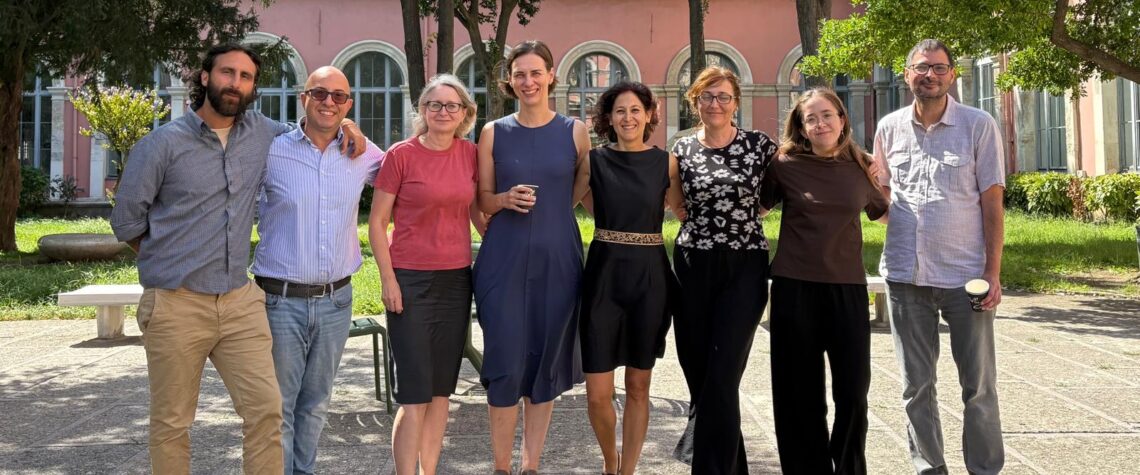
The partners of CONSPIRE – CONSPIracism and RAdicalisation Risks in Europe met in Istanbul on 4–5 September 2025 for a two-day transnational project meeting hosted by Istanbul Technical University at the Faculty of Architecture, Taşkışla Campus.
The meeting marked an important operational step for the Erasmus+ KA220-HED project, coordinated by the University of Turin, and brought together representatives from the partner institutions to review progress, align the next stages of work and strengthen the shared educational strategy of the project.
The Istanbul meeting focused on the preparation of the training programme, the development of the syllabus and competence framework, the production of video lectures and video pills, the student selection process, the role-playing methodology Conspirology, and the communication and public engagement strategy of the project.
From project design to implementation
The first day opened with a general update on project management, coordination and reporting. Partners discussed the preparation of the progress report, the Quality Management Plan and the need to ensure effective coordination in the coming months through regular online meetings.
A key point concerned the evolution of the partnership. Due to new internal administrative regulations, the Universitat Autònoma de Barcelona will remain in the project, completing its role in WP2 and contributing to dissemination activities, while the Universidad Complutense de Madrid has been proposed and approved to take over implementation activities mainly connected to WP4. The Madrid team has shown strong enthusiasm, and the formal procedure for the partnership change, including partner approval and a new consortium agreement, is expected to be completed by the end of the year.
This development strengthens the project’s European dimension and ensures continuity in the delivery of the training and participatory activities foreseen by CONSPIRE.
Building the training pathway
A major part of the meeting was dedicated to WP2 – Preparation of the training. Partners presented the state of development of the syllabus, the competence framework and the literature review, with the objective of finalising the common structure of the course.
The training programme is built around six modules, each combining academic content with professional contributions through short video pills. The modules cover the main dimensions of conspiracy thinking addressed by the project:
- an introductory module led by the University of Turin, focused on community organising and the general entry point into the project;
- a health module, now connected to the Complutense University of Madrid, addressing COVID-19, healthcare conspiracy theories, infodemic dynamics and vaccine resistance;
- a module on religion and spirituality led by the University of Turin;
- a communication, media and technology module led by Aalborg University;
- a science module led by the University of Tartu;
- a politics module led by Istanbul Technical University.
This structure reflects the interdisciplinary nature of CONSPIRE. The project combines sociology, political science, media studies, communication, science studies, religion and civic education to help students understand how conspiracy narratives are produced, circulated and challenged.
Video pills and accessible learning materials
The meeting also focused on the production of video lectures and video pills, which represent a key component of the project’s learning and dissemination strategy.
Each partner will identify professional contributors for its module, ensuring a balance of expertise, gender and nationality. The video pills will be short, accessible interviews of around ten minutes, designed to connect academic content with real-world perspectives from practitioners, journalists, scientists, activists and other relevant voices.
The partners agreed on common technical and accessibility standards: Full HD resolution, clear audio, MP4 format, short duration, structured content, mandatory subtitles, readable slides, GDPR consent for all speakers and students appearing in videos, and the use of the correct Erasmus+ co-funding statement.
The purpose is not to produce overly academic material, but to create concise, engaging and accessible resources that can support students’ learning and, where appropriate, be used for communication and dissemination.
Conspirology: learning the rules of the game
One of the central moments of the Istanbul meeting was the training and practice session dedicated to Conspirology, the role-playing game developed within CONSPIRE.
The game is one of the project’s most innovative educational tools. It brings non-formal education into formal university settings by allowing students to explore conspiracy narratives through role-playing, group storytelling, critical debate and collaborative learning.
During the meeting, partners worked on the rules of the game and on how to teach them to students during the future in-person workshops. Conspirology is structured in two phases: “Play the Conspiracy” and “Replay the Conspiracy”.
In the first phase, students will work in their local university contexts, developing and analysing conspiracy narratives through a guided educational process. In the second phase, selected students will take part in an advanced version of the game during the international mobility in Turin.
The method is designed to help students understand conspiracy thinking from the inside, without endorsing it. It supports critical thinking, media literacy, collaborative learning and awareness of the risks of radicalisation.
Student selection and course delivery
The second day of the meeting was dedicated to WP3 – Delivery of the training and to the student selection process.
The project aims to involve around 250 students, with a target of 50 students per partner university. Students will be recruited primarily from social science faculties, although partners may adapt the process according to their internal procedures.
The online course is expected to launch in February, with a flexible structure allowing students to enrol and follow the learning path through a unified Moodle platform. The course will include videos, texts and downloadable materials, with no centralised final exam. Each university will be able to integrate the course into its own programmes and apply its own procedures for credit recognition.
Tutors will play a key role in supporting students during the online course, guiding discussions, answering content-related questions and helping students engage with the learning materials.
Selection criteria may include English proficiency, motivation, gender balance and inclusion criteria, with particular attention to students with fewer opportunities or disabilities.
From university learning to public engagement
The Istanbul meeting also underlined the importance of WP5 – Public engagement, which aims to make the project visible, accessible and useful beyond the university context.
The communication plan was discussed as a shared tool to be completed collaboratively and adapted to each partner’s institutional policy. Partners were invited to publish project webpages on their institutional websites, provide logos and short presentations of principal investigators and partners, promote the project through their channels and involve associated partners in dissemination activities.
The project’s communication strategy will use websites, social media, press releases, public events, visual materials and video outputs to reach students, faculty, policymakers, educators and the general public.
The main final outputs will include Policy Recommendations, a Transferability Toolkit to adapt the course to non-university contexts, a Sustainability Roadmap to strengthen the project within academia, a visual spot, public streaming events and the final project report.
Next steps
The Istanbul meeting concluded with a clear set of operational deadlines.
Partners are expected to finalise the competence frameworks and module materials, identify experts for the video pills, complete the progress report template, provide institutional communication materials and prepare the online course for launch.
The project will also move forward with the formal approval of the Complutense University of Madrid’s entry into the partnership, the preparation of a new consortium agreement and the organisation of the next coordination meetings.
From October onwards, the project team will begin contacting experts and recording the video pills, with the aim of completing the materials by the end of the year. Partners will also prepare for student recruitment, the online course, the in-person workshops and the final mobility in Turin.
Istanbul as a step towards democratic resilience
The Istanbul meeting confirmed the value of CONSPIRE as a European laboratory for innovative higher education.
By combining academic research, non-formal education, role-playing, community organising, audiovisual storytelling and public engagement, the project is developing a learning model that helps students understand one of the most urgent challenges of contemporary democracies: the spread of misinformation, conspiracy thinking and radicalisation risks.
CONSPIRE shows how universities can go beyond traditional teaching and become spaces where students actively engage with society, develop civic competences and learn to respond critically to complex information environments.
In this sense, the Istanbul meeting was not only a coordination event. It was a concrete step in building a European educational pathway for democratic resilience, critical thinking and active citizenship.